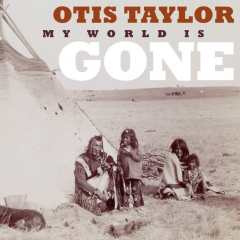
WITH HIS POWERFUL AND UNIQUE BLEND
OF ROOTS MUSIC AND NARRATIVE POETRY
My World Is Gone explores the struggles of Native Americans
with contributions from Indigenous frontman/guitar virtuoso Mato Nanji
BOULDER, Colo. — Roots music visionary Otis Taylor’s 13th album, My World Is Gone, set for release February 12, 2013 on Telarc, a division of Concord Music Group,
is a lightning bolt of musical creativity and social commentary. Its
songs crackle with poetic intelligence and a unique, adventurous sound
that balances the modern world with echoes of ancient Africa, Appalachia
and more.
To
call Taylor a cutting edge artist is an understatement. Although his
music is based in the blues and folk realm, his meticulously crafted
recordings crash the barriers of jazz, rock, funk, Americana and myriad
other genres to create a hybrid that Taylor labels “trance blues.” And
that signature style serves as a backbone for his frank tales of
struggle, freedom, desire, conflict and, of course, love.
The central theme of My World Is Gone was fueled by Taylor’s friend Mato Nanji, the singer-guitarist and cornerstone of the band Indigenous.
“Mato inspired the entire direction of this album,” Taylor relates. “We
were talking about history backstage at a Jimi Hendrix tribute concert
that Mato had just played, and, in reference to his people, the Native
American Nakota Nation, he said ‘My world is gone.’ The simplicity and
honesty of those four words was so heavy, I knew what I had to write
about.”
Taylor had already begun composing new tunes with other themes for his follow-up to 2012’s critically heralded Contraband. Three of those — “Green Apples,” “Gangster and Iztatoz Chauffeur” and “Coming With Crosses” — appear on My World Is Gone.
But
inspired by Nanji — who plays electric and acoustic guitars on six
tracks and joins Taylor on vocals for several songs — and by his own
understanding of Native American culture developed in part through
dealing in Indian art as a young man, Taylor embarked on a
soul-searching journey into the past and present, and into the psyche,
of America’s indigenous people.
“I’ve
written songs about slavery, but here in America that’s considered part
of the past,” Taylor explains. “What’s happened and what’s happening to
Native Americans is still going on. A lot of people forget that. This
is a reminder.”
With
his customary brevity, power and grace, Taylor conveys his stories in
intimate detail and uses his rich baritone voice to give his characters
breath and humanity. The album starts on point with “My World Is Gone,”
portraying how the gilded seductions of the white man’s culture
undermined the Native American way of life. The melancholy in Taylor’s
and Nanji’s vocal performance, as they sing from the perspective of an
Indian tormented by temptation and loss, is buoyed by the gentle
melodies of Anne Harris’ fiddle and Nanji’s electric and acoustic
guitars — the acoustic six-string an Otis Taylor signature model, with
only 14 frets, built by the premier instrument makers at Santa Cruz
Guitars.
Taylor revisits his song “Lost My Horse,” which originally appeared on 2001’s White African, with a new arrangement that features him and Nanji trading guitar and mandolin lines.
“In
the days of the frontier, having a horse could be a matter of life or
death, or comfort or poverty, and the horse has been an important part
of Native American culture in the west, so the song fit perfectly,” he
explains.
“Sand
Creek Massacre Mourning,” which recounts the murder of 200 Cheyenne and
Arapaho victims by Col. John Chivington’s cavalry in 1864, rests on the
backbone of Taylor’s banjo, his primary instrument. He’s played mostly
electric banjos on previous albums, save for 2008’s roots-focused Recapturing the Banjo, but on My World Is Gone Taylor employs
four-, five- and six-string acoustic models. “I wanted to get back to
that organic sound, because the banjo’s spoken to me since I was a kid,”
he says. “Its voice instantly brings you back in time, and so much of My World Is Gone is about history and tradition that its sound is perfect for these songs.”
Nanji
again shares vocals with Taylor on “Blue Rain in Africa,” in which a
Native American reflects on the survival of his culture, despite the
odds, after seeing the birth of a white buffalo — a rare and highly
sacred event — on TV. The song’s threads of hope are a striking contrast
to “Never Been to the Reservation,” with its lyrics about “babies
sleeping on the ground,” although both numbers benefit from Nanji’s
burnished blues licks.
While
Taylor’s vision can be dark and ominous — the title “Coming With
Crosses” is self-explanatory — his songs often celebrate hope and beauty
in poignant ways. “Jae Jae Waltz” uses its spare construction of banjo,
drums, bass and guest Ron Miles’ cornet to tell a story of a widow’s
search for new love, and “Sit Across Your Table” celebrates the comfort
and joy a workingman takes in his marriage. The song is also a
surprising foray into untempered rock ’n’ roll, with a wailing guitar
solo by Shawn Starski.
Starski
and Taylor are versatile musicians who make their six-strings sound
like an African kora on both “Green Apples” and the quirky Elmore
Leonard-like tale “Gangster and Iztatoz Chauffeur.” Starski is the
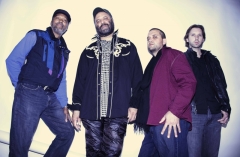
latest addition to Taylor’s touring band, which also includes Anne
Harris on fiddle, Larry Thompson on drums and bassist Todd Edmunds, who
has replaced Taylor’s daughter Cassie, a fixture of his earlier albums
and groups. She now leads her own band, Cassie Taylor & the Soul
Cavalry.
Otis
Taylor’s own parents were an important part of his musical foundation.
His father was a passionate jazz fan who encouraged his son to become a
musician. His mother has become the subject of several of Taylor’s
songs. Although he was born in Chicago in 1948, his parents relocated
their family to Denver when Taylor was a small child in part to protect
their son from the harsh realities of urban living. In addition to
listening to jazz in his father’s record collection, he fell deeply
under the spell of the Mississippi Delta legend John Lee Hooker, whose
spare, almost mystical sound still resonates in Taylor’s own work.
“I
get a lot of my sense of space and my vocal phrasing from John Lee
Hooker, whose music, especially his solo recordings, is so heavy and has
so much space that it sounds like it’s alive,” Taylor explains. His
other vocal totem is James Brown, whose shouts and howls inspire the
thunderous vocal declamations that punctuate many of Taylor’s own
recordings.
As
a young man, Taylor mastered the banjo and moved on to the harmonica
and guitar. He performed with electric guitar virtuoso Tommy Bolin as
T&O Short Line, and by 1974-76, he was playing bass as part of the
Boulder-based rock group Zephyr. Taylor even jammed with Jimi Hendrix
once and pursued his muse to Europe, but frustrations with the music
business led him to retire from performing in 1977. He became a dealer
in art and antiques, and pursued another of his passions, bicycle
racing, as a coach.
In
the ’90s, the door to Taylor’s musical past was pried open by friends
in the Boulder area, and in 1996, he independently released his debut
album, Blue Eyed Monster. With the release of his next two discs, When Negroes Walked the Earth and White African,
he began to shake up the blues world with his marvelously original
music and his unflinching tales about racism, struggle and heritage.
Over the years, Taylor has garnered more than a dozen Blues Music Awards
nominations, and White African won Best Debut Album. He is also
regularly nominated as an instrumentalist, and won a Blues Music Award
for his imaginative banjo playing in 2009. Also, his albums Double V, Definition of a Circle and Recapturing the Banjo took Downbeat’s Best Blues CD awards in 2005, 2007 and 2008, respectively. In all, Taylor has won five DownBeat awards. He has also been nominated twice for the prestigious
Académie Charles Cros award in France.
His 2009 recording, Pentatonic Wars and Love Songs, was released in the same week that two of Taylor’s songs were heard by millions in Michael Mann’s blockbuster movie Public Enemies starring Johnny Depp and Christian Bale.
In
2010, Taylor started his own annual Trance Blues Festival in Boulder,
Colorado, which brings a broad cast of professional and amateur
musicians together for three days of performances, jams and workshops.
“The
thing about music is that it’s not just a spectator sport,” Taylor
says. “In a world where there’s a lot of misunderstanding, music can
help people communicate and break down barriers, and start to really see
each other for who they are.
“I
write songs about people remembering, bearing witness,” Taylor
continues. “I’ve learned that if you write about things that are
important, people will listen. That’s one of the reasons why I wrote the
songs that I did for My World Is Gone.
“I
push myself to be prolific and to make every new album better than the
last one for personal reasons, too,” he relates. “A few years ago I had a
cyst removed that was attached to my liver and spine. It was a
life-threatening situation — really painful. I didn’t know if I was
going to survive the surgery. I came to grips with the idea that the
albums I’m making are going to be my legacy. And I want the people who
love me — my family, my friends — to be proud.”
For more information about Otis Taylor, please contact:
Cary Baker • Conqueroo • (323) 656-1600 • cary@conqueroo.com
Mike Wilpizeski • Concord Music Group • 718-459-2117 • Mike.Wilpizeski@concordmusicgroup.com
Tour Publicity: Kelly Johanns-DiCillo • Concord Music Group • 216-464-2313, x2470 •
Kelly.Johanns@concordmusicgroup.com
If you support live Blues acts, up and coming Blues talents and want to learn more about Blues news and Fathers of the Blues, – ”LIKE” —Bman’s Blues Report— Facebook Page! I’m looking for great talent and trying to grow the audience for your favorite band!