Dustin Arbuckle made Bman's best-of list once: 2024
Center Stage
Dustin Arbuckle - Exclusive Interview
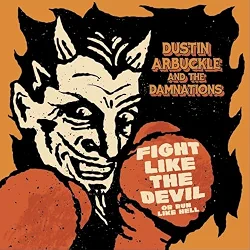
Out of Wichita, Kansas, Dustin Arbuckle & The Damnations make the kind of gritty, groove-heavy Blues that feels right at home in a dusty roadhouse or on a late-night drive. Led by powerhouse singer and harmonica player Dustin Arbuckle (who you might know from his years in Moreland & Arbuckle) the band effortlessly mixes Delta blues, Southern soul, and roots rock without ever feeling tied down to one genre. Alongside Brandon Hudspeth, Caleb Drummond, and Colby Aiken, Arbuckle has built a group with effortless live chemistry, showcased on their recent album, Fight Like the Devil (Or Run Like Hell). Check out the video in Centerstage to see them in action, then stick around as we catch up with Dustin to chat about the new tunes, life on the road, and everything in between.
Bman: When I reviewed the new record on the Report back in August, I noticed a very distinct sonic shift compared to your earlier albums with the Damnations. How would you describe the musical direction you guys targeted for this project, and what led you there?
Dustin: We wanted to go for a more focused sound on this album and really lean into the core of our sound, electric blues with a bit of roots-rock edge. I think on our previous albums, we might have tried a little too hard to represent the band's cross genre approach that is our calling card as a live act. I often say that we're very a "blues-centric" band, but we also love to play honky-tonk country, rock, soul, and jazz tunes. Because of the versatility of all the guys in the band, I think we are able to pull it all off pretty tastefully and effectively. From the beginning, the variety of music we play is one of main things fans and promoters have said they enjoy about the band's live show. Unfortunately, in the studio, that approach can end up feeling scatter-shot and more like a collection of songs than an album with a more cohesive theme or vibe. We wanted to make an album where everything fit together a bit better and I'm very happy with the result.
Bman: Yeah, I totally get that. I love your albums and I definitely love to see a band stretch in concert, so I think it’s good reasoning.
I’ve been covering this lineup since your self-titled debut in 2020. Six years later, the interplay between your harmonica and Brandon's guitar work on tracks like 'Heaven Forbid' is incredibly tight. How has your collaborative relationship changed or grown since those early days?
Dustin: The band has always been pretty collaborative, but after almost 10 years together, that spirit has only continued to grow. The interplay between myself and Brandon is certainly a big part of that. We've spent so much time and played so many shows together at this point that we really understand each other musically and we each know how to work with AND around the other. There's a lot of trust and mutual respect. All of that extends to Caleb (bass) and Colby (drums), as well. Everyone made significant contributions to the writing process on this album.
Bman: The band really is tight so it’s working great!
Our readers loved Live At The Shamrock because of how raw and immediate it felt. When you went into the studio to cut these new tracks, what was your approach to capturing that same fierce, primitive punch in a recorded environment?
Dustin: Thank you! I think "Live At The Shamrock" was a great representation of our live show, in large part because you could feel the live energy. I think it's very important, especially with a band of our ilk, to make sure we don't lose that energy in the studio. We like being able to play together in the same room and record the bed tracks (drums, bass, rhythm guitar) live, which I think helps to maintain a lot of that energy because we can feed off of each other's energy like we would in a live setting. For me, doing it that way feels more natural. Weights & Measures Soundlab in Kansas City, where we recorded the bulk of the album, has a big open room that allowed us to record like that, which was a big reason we chose it. Duane Trower, the engineer at W&M, also listened to us and understood the vibe we wanted. He did a great job of helping us get the sounds we needed.
Bman: Yeah. You definitely nailed that. Great instincts!
We are proudly featuring your video performance of Art Blakey’s: 'Moanin'' on the site “Centerstage” right now, and I absolutely love your take on it. What first inspired the band to tackle a classic Blakey jazz piece, and what was the journey like adapting that heavy horn melody over to the harmonica?
Dustin: Thanks! That's such a fun tune to play! It was our bass player, Caleb, who had the idea to play "Moanin". I hadn't been familiar with the song prior to him playing it for me, but it hooked me pretty fast. The head is super catchy, and it struck me as a tune we could do well. We've always liked to have a couple jazz instrumentals in the regular rotation because they're a nice change of pace in the set and let us stretch out musically. Brandon, Caleb, and Colby all have a fair amount of background playing jazz, so they know a bunch of classic jazz tunes and it's easy to come up with ideas. I have to admit that it can be a challenge for me to hang on with them on some of that stuff, but there are a bunch of jazz standards that have melodies/heads that aren't crazy difficult to play on diatonic harmonica. Amplified harmonica occupies a similar sonic space as saxophone, and fills the same role in a band, so it's a pretty natural fit. A lot of blues harp greats have done beautiful versions of jazz tunes, such as Butterfield's version of "Work Song" and Charlie Musselwhite's classic take on "Cristo Redentor", to name a couple of my favorites. It's kind of a boring answer, but it's really just a matter of putting in the time and effort to listen and learn the song.
Bman: No. I think that you’re spot on. Butterfield, Bloomfield, Bishop and Musslewhite were all cut from that cloth. That hardbop sound has a lot more in common with the blues than most people understand. A lot of bands interweave jazz riffs into their solos and have no idea where they come from. I love your raw blues sound but the contrast is killer.
Tracks like 'Must Be Travelin' On' and 'Small Branch Motel' paint a vivid picture of life on the highway. You’ve spent a massive portion of your life touring. When you sit down to write about the road these days, are you drawing from immediate tour experiences, or are you looking back at older memories?
Dustin: Truthfully, when I write that kind of song, I'm usually not drawing directly on my own personal experiences and memories of life on tour. Sometimes a phrase or an image related to something I've experienced will get included because I feel the connection and it fits well into the narrative of the song, but the overall story isn't really based on my life as a touring artist. I think the biggest reason that I write so many songs that are "road songs" in one way or another is that I'm drawn to the concept of the journey. It's a theme I've returned to many times in my songwriting throughout my career and it's always happened pretty organically. I don't think I've ever sat down with the plan of writing a traveling song, but inspiration has sent me in that direction a lot. With all that being said, I don't think it's a stretch to say that spending most of my adult life on the road has probably contributed to my inclination to write those songs and my comfort with the subject.
Bman: Yeah, I actually get that and there is a bit of wanderlust in all of us I think.
We love talking gear on Bman's Blues Report. What does your current touring rig look like right now, and how do you go about chasing the specific tone you hear in your head?
Dustin: I personally love the sound of small amps for harmonica. For most of the last 15 years, I've usually used two small amps that I connect with an AB-Y splitter so they're both running all the time and the tones are blended. One is a National 10 model by Vintage 47 Amps, who build GREAT gear, by the way. It's a clone of a mid 1950s Valco amp and has been my workhorse forever. It breaks up nicely without getting too loud, but also has more depth and body to the tone than you'd expect for a 12 watt amp with a single 10" speaker. For the other amp, I usually use either a late 1950s Rickenbacker or a mid 1960s Kalamazoo Model 2. Both of those have snarkier tone than my Vintage 47, so the blend of the tones is great! I honestly don't know the wattage of the Kalamazoo, but it's also a single 10" speaker. The Rickenbacker got "Frankensteined" a bit before I got it, so I'm not sure what it was like originally, but now it's 15 watts with an 8" speaker. My main harp mic is a custom build by Roger Nelson of Kingtone Mics in Melbourne, Australia. It has a dynamic element, which works well with the amps I use. Plus, the shape and size of the shell is a perfect fit for my hands, which is a big deal for amplified harmonica tone.
If I'm in a position to bring out a bigger amp at a festival or something like that, I have a 1955 Fender Bassman, which sounds amazing. It used to belong to the late Lee McBee, who was a great singer/harmonica player from the Kansas City area, and a dear friend and musical mentor to me. The 1959 Bassman seems to be viewed as the "classic" model, but the earlier models are absolutely killer, especially for harmonica. They're a bit lower wattage, and according to an electrical engineer friend of mine (also a harp player), the circuit of a '55 Bassman is a little different than the '59 in a way that gives it a little extra "special sauce" as a harp amp. I don't have the technical knowledge to explain why, but it's an absolutely beautiful sounding amp.
Bman: Oh, I get it. On the old fender amps the bias would change as the tubes would burn in and the caps only got changed when they smoked. I remember Fender borrowing Buddy Guy’s Bassman wanting to blueprint it. What they found was there was hardly a cap in it that was close to spec. “That was the sauce”. Replacing the caps with new, in the blueprinted clone it sounded flat and boring. On my guitar amps I love the smaller amps like Valco and the fender champ. They made such great amps and low watts. I personally liked the Trayner heads which I used to hot plate and Hiwatt Custom 100 and Vibrolux and Super Reverbs but you have to push them so hard you go deaf.
Now that you’ve been out on the road playing these new tracks night after night, which song from Fight Like the Devil has completely transformed or surprised you the most once you started feeding it to a live crowd?
Dustin: I'd have to say "Always Gone". In all honesty, that song was kind of an afterthought when we recorded it. I wrote it a few years ago and played it quite a bit with my buddy Matt Woods, with whom I have a guitar/harmonica duo, but in a VERY different arrangement. We'd tried adapting it for The Damnations' a couple times, but the song never stuck in the set because we hadn't found an arrangement for it that we really liked. The minor keyed, slow blues version we ended up recording didn't come together until we were in the studio and we'd decided the album was missing a song with that vibe. As a result, we'd barely played it live before the album came out, which is pretty out of the ordinary for us. Most of our songs get worked into our live shows as soon as we write them, so they've been pretty well "road-tested" before we record them and we know how they go over with the crowd. We didn't know what to expect with "Always Gone", but since we started playing this new arrangement of the song live, it's gotten a great response and has become a staple in our set list. I have to give our drummer Colby credit, because I think he was the only one in the band who thought it was a particularly strong tune when we recorded it, so he clearly realized something the rest of us didn't on that one. It just goes to show you never can tell.
Bman: I really appreciate you taking the time to talk with us, Dustin. Keep cranking out the music—you still have one of the best sounds on the street. I know Fight Like the Devil (Or Run Like Hell) is going to earn a spot on the 2026 Best Of lists, just like your past records.
Dustin: If I'm in a position to bring out a bigger amp at a festival or something like that, I have a 1955 Fender Bassman, which sounds amazing. It used to belong to the late Lee McBee, who was a great singer/harmonica player from the Kansas City area, and a dear friend and musical mentor to me. The 1959 Bassman seems to be viewed as the "classic" model, but the earlier models are absolutely killer, especially for harmonica. They're a bit lower wattage, and according to an electrical engineer friend of mine (also a harp player), the circuit of a '55 Bassman is a little different than the '59 in a way that gives it a little extra "special sauce" as a harp amp. I don't have the technical knowledge to explain why, but it's an absolutely beautiful sounding amp.
Bman: Oh, I get it. On the old fender amps the bias would change as the tubes would burn in and the caps only got changed when they smoked. I remember Fender borrowing Buddy Guy’s Bassman wanting to blueprint it. What they found was there was hardly a cap in it that was close to spec. “That was the sauce”. Replacing the caps with new, in the blueprinted clone it sounded flat and boring. On my guitar amps I love the smaller amps like Valco and the fender champ. They made such great amps and low watts. I personally liked the Trayner heads which I used to hot plate and Hiwatt Custom 100 and Vibrolux and Super Reverbs but you have to push them so hard you go deaf.
Now that you’ve been out on the road playing these new tracks night after night, which song from Fight Like the Devil has completely transformed or surprised you the most once you started feeding it to a live crowd?
Dustin: I'd have to say "Always Gone". In all honesty, that song was kind of an afterthought when we recorded it. I wrote it a few years ago and played it quite a bit with my buddy Matt Woods, with whom I have a guitar/harmonica duo, but in a VERY different arrangement. We'd tried adapting it for The Damnations' a couple times, but the song never stuck in the set because we hadn't found an arrangement for it that we really liked. The minor keyed, slow blues version we ended up recording didn't come together until we were in the studio and we'd decided the album was missing a song with that vibe. As a result, we'd barely played it live before the album came out, which is pretty out of the ordinary for us. Most of our songs get worked into our live shows as soon as we write them, so they've been pretty well "road-tested" before we record them and we know how they go over with the crowd. We didn't know what to expect with "Always Gone", but since we started playing this new arrangement of the song live, it's gotten a great response and has become a staple in our set list. I have to give our drummer Colby credit, because I think he was the only one in the band who thought it was a particularly strong tune when we recorded it, so he clearly realized something the rest of us didn't on that one. It just goes to show you never can tell.
Bman: I really appreciate you taking the time to talk with us, Dustin. Keep cranking out the music—you still have one of the best sounds on the street. I know Fight Like the Devil (Or Run Like Hell) is going to earn a spot on the 2026 Best Of lists, just like your past records.
■ BMAN'S BLUES REPORT ■
Rate this review
Be the first to rate this review